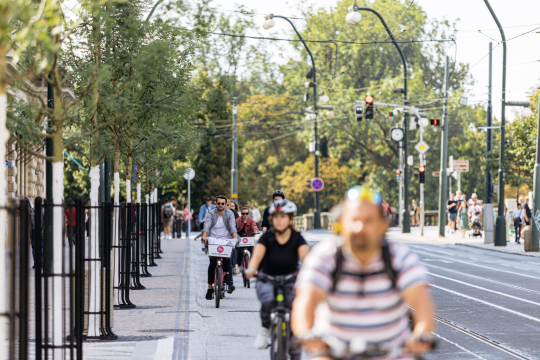
Reconstruction of the Prager Cubes begins, focusing on recycling and a return to the original design.
The Prague Institute of Planning and Development (IPR Prague) and the Center for Architecture and Metropolitan Planning (CAMP) are entering the final days at their current home. The buildings are set to undergo a complex reconstruction, which will incorporate principles of reuse and circularity and bring the iconic buildings closer to Karel Prager’s original design.
People can come to CAMP to say goodbye
Throughout June, the Emauzy complex is hosting “Construction Approved,” a special program where visitors can take part in recycling workshops or see site-specific artistic interventions, among other activities. Fifteen creative figures, including Vladimir 518, TIMO, Lenka Tyrpeklová and Krištof Kintera, have jointly created an exhibition that will culminate on June 25th with a party featuring music, food, and a light installation. This is the last opportunity to visit the Prager Cubes before they are scheduled to be reopened in approximately three years. The new CAMP is set to open in the fall in a former boat repair facility at Pobřežní 20a in Karlín.
The reconstruction will be circular
An inventory of the interior furnishings is currently underway. Some items are being moved to IPR Prague’s temporary premises in Holešovice. Items that cannot be accommodated or reused are being offered by IPR Prague to city institutions, non-profit organizations and the public. Tables, cabinets, refrigerators, and sofas are among the items attracting interest.
Ondřej Boháč, Director of IPR Prague, says: “The buildings will be left with bare partitions and empty rooms. The next step will be to dismantle the individual elements. This means that no one will come in with a hammer and demolish the building’s interior; instead, the elements will be carefully dismantled one by one so that they can potentially be reused,”. This is the first circular reconstruction project carried out by a public-sector client in Prague.
The work will follow a pre-reconstruction audit prepared by the Czech Technical University in Prague (ČVUT), which maps opportunities for recycling and further reuse of construction materials such as steel elements, concrete, bricks, and glass. It also determines how much of each material can be recycled and the savings this could generate. The materials will be carefully dismantled, sorted, and prepared for further use. IPR Prague is working with Cyrkl on both stages of the circular process; the company has previous experience with this approach.
“The aim of circular reconstruction is not simply to minimize the amount of waste. We are trying to keep as many materials and pieces of equipment as possible in circulation and find new uses for them. Every table, door or building element that does not need to be replaced with a new product represents savings in raw materials, energy and emissions. At Cyrkl, we focus on precisely these practical solutions—we connect data, knowledge of material flows and partners who can give materials a second life,” explains Martina Škvorová of Cyrkl.
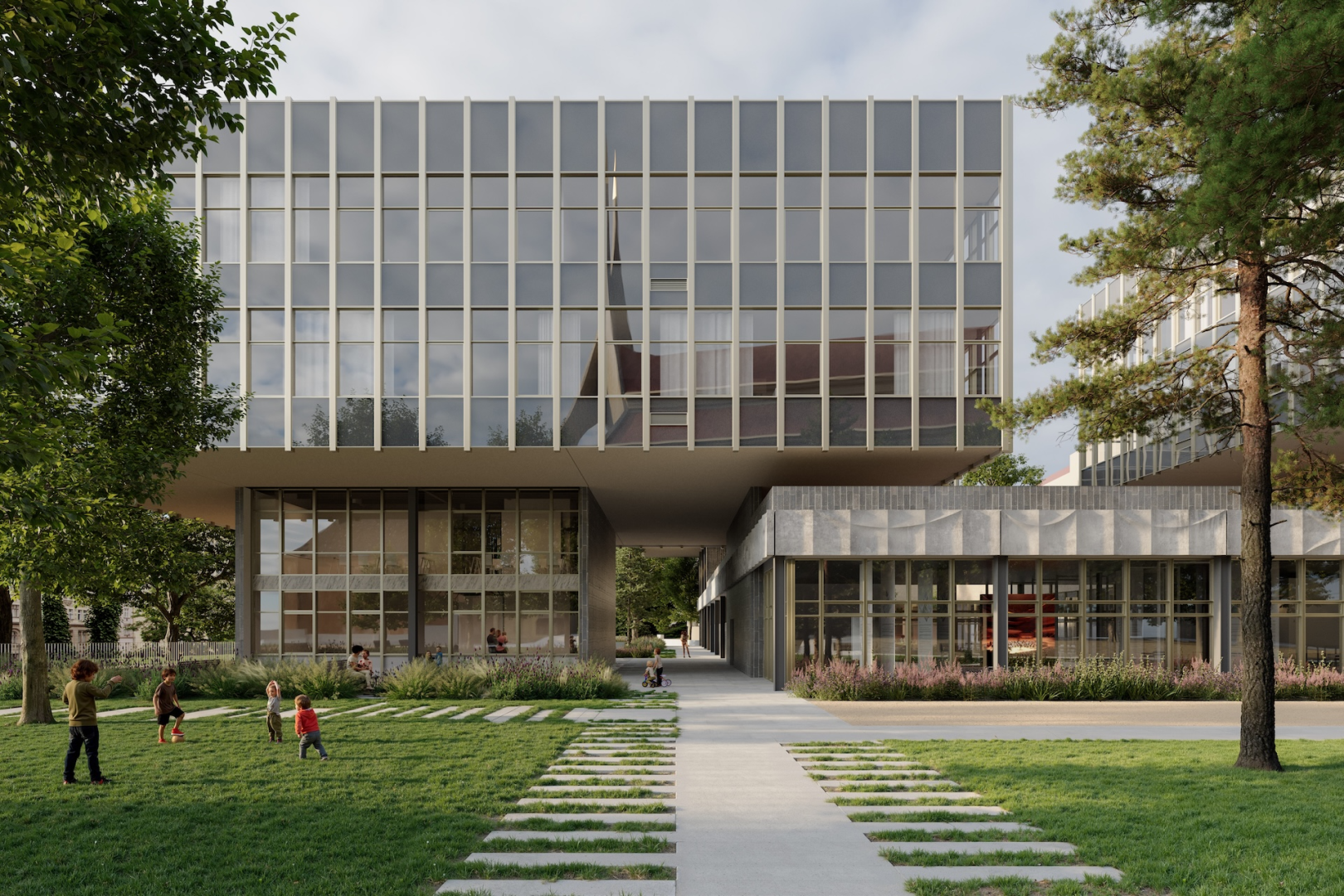
The Prager Cubes will end up closer to their intended design
The original vision of Karel Prager and Jiří Kadeřábek for the Emauzy cubes included not only modern offices and an exhibition hall, but also publicly accessible terraces and greater openness to the city and its residents. A careful but extensive reconstruction is necessary, as the modernist complex has not undergone a major renovation since its completion in 1975. Its current condition does not meet today’s requirements for energy efficiency, fire safety, hygiene, or technical equipment. The project also includes a complete renovation of the building envelope and modernization of its systems, while architecturally valuable elements such as the original wall and floor coverings, light fittings, and door handles will be preserved. The reconstruction is expected to take three years and cost CZK 1.4 billion. Most of the funding will be provided by Prague City Hall. The contract for the reconstruction was signed last summer by representatives of PORR, Metrostav DIZ, and IPR Prague.
Visualizations and photographs can be found in the PRESS KIT.
You might also be interested in
Higher-quality paving and succulents between the tracks; Prague presents a new standard for tram tracks.
Expert consultations held as part of the update to Prague’s public lighting strategy.