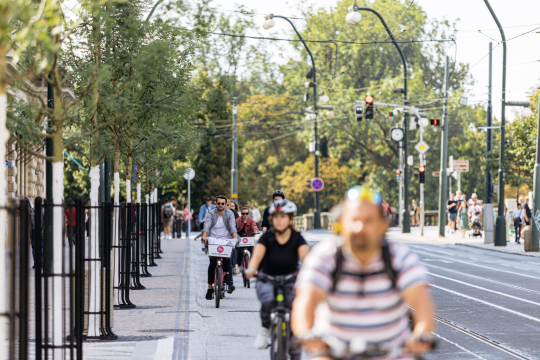
The Metropolitan Plan protects localities, viewsheds, and nature, and will enable faster development of housing and transport. Come to the “public preview” to learn more.
The Metropolitan Plan of the Capital City of Prague is now on display both at the Center for Architecture and Metropolitan Planning (CAMP) and online, and includes incorporated comments from the public and city districts. The Metropolitan Plan concerns anyone who lives in or commutes to Prague, as it defines the city’s boundaries, densifies it, protects its natural areas, and enables more efficient planning and faster construction. It is scheduled for approval in the first half of next year.
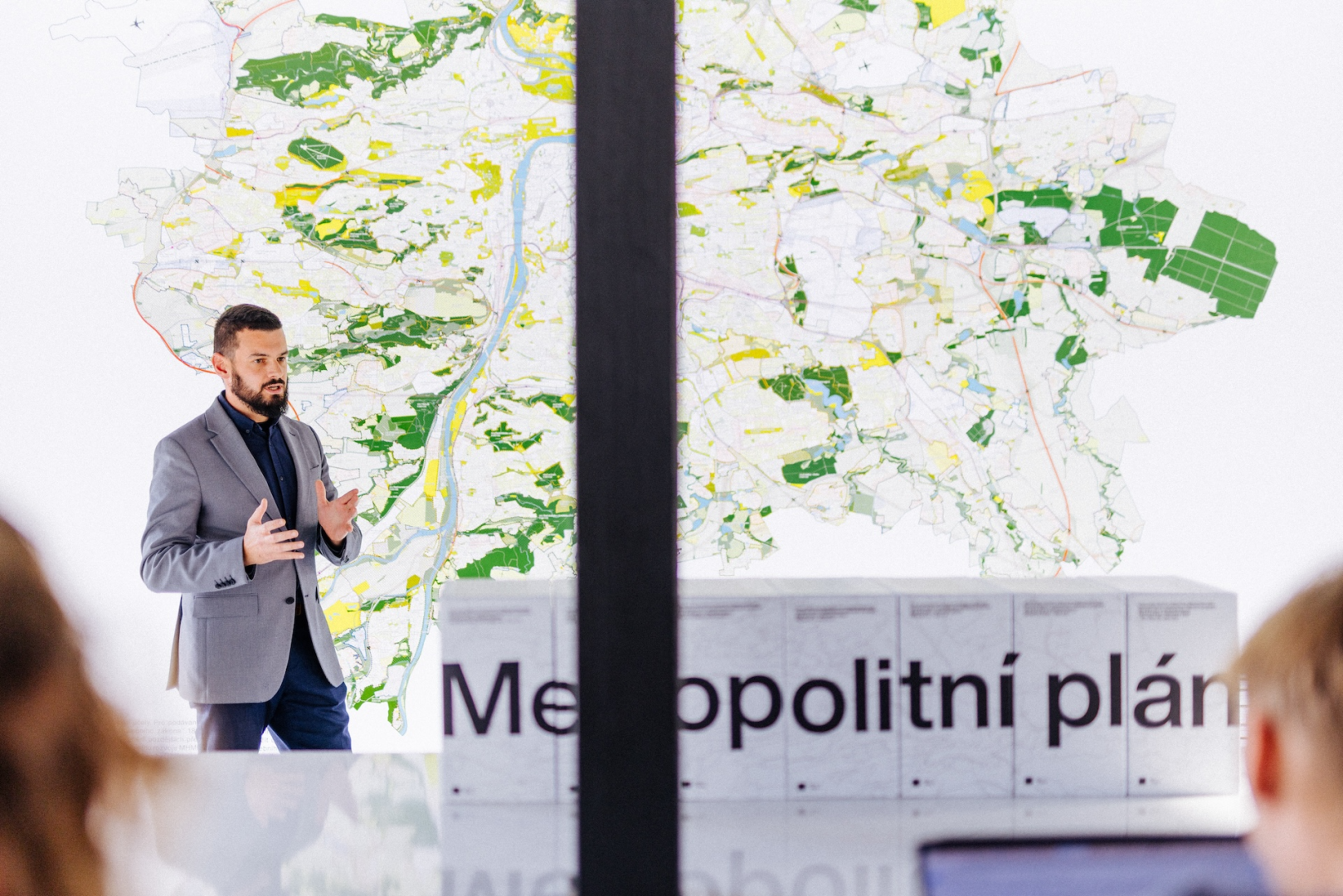
“The approval of the Metropolitan Plan will change Prague. It will remove the obstacles holding back Prague’s development and enable its residents to have everything they need for a good quality of life in a modern European metropolis in the coming decades — from enough housing and quality public spaces and services, to fast and comfortable transport connections,” says Bohuslav Svoboda, Mayor of Prague.
The Metropolitan Plan will enable more intensive development of the city. It protects the character of more than 700 Prague localities, as well as nature inside and around the city, the historic center, and the city’s views, while anchoring major transport projects and investments. It opens up brownfields for the construction of new districts, making it possible to build up to 350,000 new flats, as well as public facilities such as schools and hospitals.
“The new Metropolitan Plan is the foundation that will allow for fast and responsible permitting. It is the first fully digitalized plan for Prague and includes all state and city investment projects. For private projects, the plan also mandates a planning agreement if the developer’s land gains value as a result. The Metropolitan Plan thus enables rapid and large-scale construction while guaranteeing sufficient public facilities,” says Petr Hlaváček, Deputy Mayor of Prague for Spatial and Strategic Development.
“The plan before us represents the broadest possible agreement on the future of Prague. We have spent 12 years working on it. The new Metropolitan Plan takes into account countless conflicting interests and viewpoints. I am glad we have reached consensus on what every Prague locality should look like, and I am sincerely proud of both the result and the process that led to it,” says Ondřej Boháč, Director of IPR Prague.
Expert Discussions and Public Hearings
After the publication of the Metropolitan Plan, its procurer — the Department of Spatial Development of Prague’s City Hall — and its author — the Prague Institute of Planning and Development (IPR Prague) — will present the proposal in more detail. In November, several accompanying public events and expert discussions will take place, along with two public hearings. Property owners and city districts can submit comments online via the Portál Pražana (Prague Citizen Portal) from the moment the plan is published. People can comment on the parts of the plan that have changed since the last hearing.
“Each comment we received was assessed individually and evaluated in terms of balancing public interests, which were often conflicting. In total, we processed more than 60,000 requests,” says Filip Foglar, Director of the Department of Spatial Development. He adds: “We believe that during the public review process, people will appreciate that they will not have to re-enter their comments, but rather will be able to use their original submissions from 2022 via the Portál Pražana — for example, to confirm them as approved or positively resolved.”
Submitting Comments
Comments and objections are submitted online in digital form via the Portál Pražana and the Spatial Development Portal. This method is not only more convenient but also helps prevent possible errors that could invalidate submissions.
Using this process will help commenters meet all legally required conditions with the help of an intuitive guide. Submissions are sent directly to the electronic registry of Prague City Hall. Commenters receive confirmation of submission or delivery to their own data mailbox.
Approval
Prague’s land use plan currently in use was created in the 1990s and approved in 1999, but no longer meets the city’s needs. The Metropolitan Plan will be approved by the Prague City Assembly before the summer of 2026, and there is consensus across political parties on its adoption.
“The Metropolitan Plan is crucial not only for the strategic management of the city’s development but also for ensuring legal and procedural certainty in connection with the new Building Act. The plan is therefore both a technical and legislative necessity. The time limitation of the current plan was also the reason why the city accelerated the preparation of the Metropolitan Plan — to ensure continuity in planning and avoid a situation where Prague would be left without valid spatial planning documentation. For the plan to truly fulfil its role, it is essential that building authorities and the entire permitting system function effectively. Only then will it be possible to ensure the city’s development under the new rules,” says Tomáš Pek, Chair of the Prague Assembly Committee for Spatial Development, Urban Planning, and Heritage.
“I am glad to be part of the final phase of approving the Metropolitan Plan. Prague needs it urgently. What bothers me, however, and what I will pay close attention to in the future, are the strict height limits. I think Prague is being more papal than the Pope here — in a hilly city like Prague, not allowing taller buildings seems frankly absurd to me. In any case, I would like to thank Petr Hlaváček and the IPR Prague team for 12 years of thorough work,” says Patrik Nacher, Chair of the ANO Party Club and Member of Parliament.
“We welcome that the Metropolitan Plan provides capacity for 350,000 housing units and that it concentrates construction mainly on brownfields and within walking distance of rail transport,” says Daniel Mazur, Councilor for ICT, Smart City, Science, Research, and Innovation.
“Prague needs a modern and sophisticated plan that moves its development into the 21st century. I would also like to call on all Prague residents to study it carefully — especially the areas around their homes, schools, and workplaces. This is our last opportunity to comment on the plan. I consider it a great success that, based on my proposal, the Metropolitan Plan includes a land reserve for the fifth metro line — the circular Metro O,” says Adam Scheinherr, Chair of the Praha Sobě party.
“I would like to thank Petr Hlaváček, IPR Prague, and the Department of Spatial Development for bringing to completion a process that lasted 15 years. Unfortunately, however, the Metropolitan Plan is based on a controversial original concept that lacks so-called ‘conciliation negotiations’ between the involved state authorities. The final proposal rightly prioritizes construction on brownfields and in areas close to public transport. It also sets parameters for comprehensive urban development with all necessary functions for decades ahead. I am glad it does not include construction on controversial greenfield sites, as proposed by the Pirates. However, I miss broader support for high-rise buildings in suitable locations and higher building density across the city. As a result, Prague is not using its full development potential, increasing the percentage of built-up areas, and reducing space for blue-green infrastructure,” adds Milan Urban, Chair of the SPD Club at Prague City Hall.
More information can be found here, you can view the plan here, and submit your comments here.
You might also be interested in
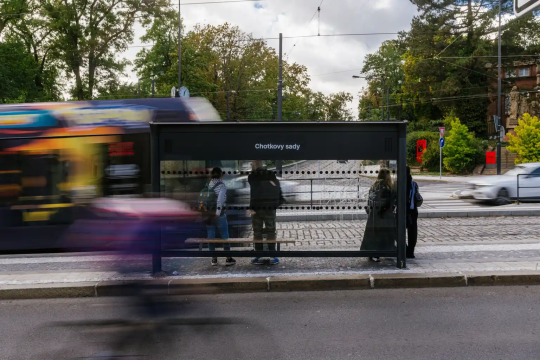
Higher-quality paving and succulents between the tracks; Prague presents a new standard for tram tracks.
Expert consultations held as part of the update to Prague’s public lighting strategy.