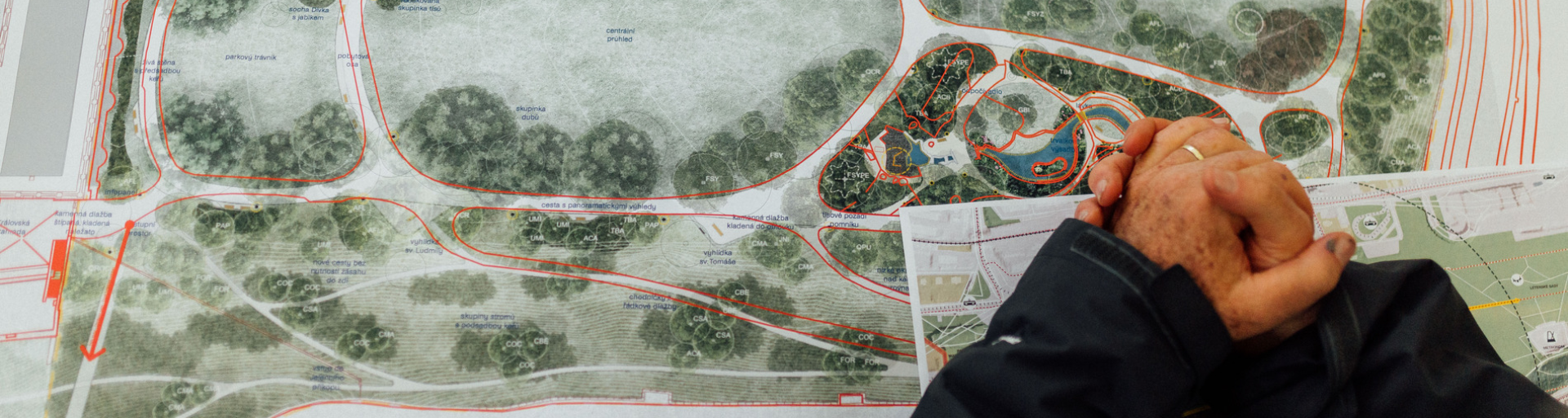
One of the most sensitive topics in the project was the planned renewal of the park’s vegetation, particularly the health of existing trees, necessary arboricultural interventions and potential tree removal. Discussions focused on the gradual renewal of the tree population, self-seeded species, and trees planted in recent decades at the request of local residents. The original landscape composition of the park, designed by František Thomayer and based on carefully planned views from the Vltava River towards the Queen Anne’s Summer Palace, represents one of the key heritage values of the site.
To address questions around tree management, a dedicated arborist-guided walk was included in the participation process. Experts explained the historical concept of the park, the health condition of individual trees, and the reasons behind proposed interventions in relation to tree diseases and the impacts of climate change. A key part of the communication was ensuring that every tree would be assessed individually based on professional arboricultural evaluations and that decisions would not be made through a blanket approach. The event attracted approximately 50 participants and demonstrated that transparent communication, supported by expert knowledge, can help prevent conflicts and strengthen public trust in the restoration process.
Another important topic was pedestrian and cyclist safety. The existing cycle route currently passes through the park, creating conflicts between cyclists and pedestrians. Public feedback was reflected in the proposal: the cycle route will remain only in the section connecting to the bridge from Letná Plain, before being redirected outside the main park areas. The proposal therefore seeks to improve safety while maintaining an important cycling connection.