
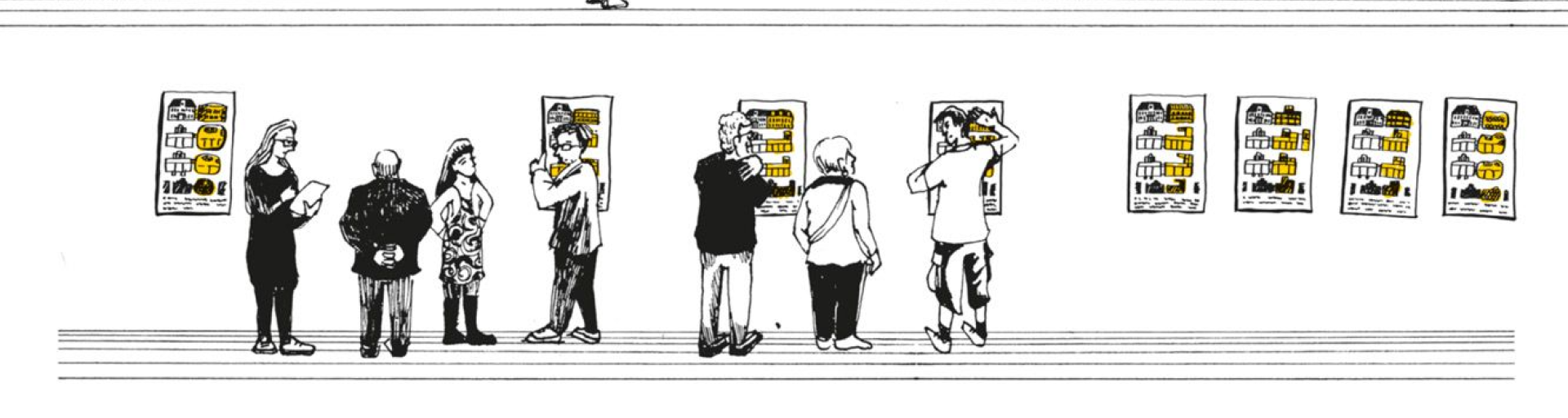
Step 06 – Analysis of Needs (1st phase of participatory planning)
6.1 Description and objective
A needs assessment works much like analyzing user behavior during a website redesign: we examine where people get lost, what they find unclear, where they click without response, which texts or images confuse them, and which visual elements distract them. Step 6 serves the same purpose when planning or revitalizing public spaces, services, or programs – revealing barriers, needs, and opportunities from the user’s perspective.
Beyond identifying user needs, step 6 also helps uncover context, local specifics, and relationships in the area that may not be immediately visible.
It can also be used to gather opinions on specific themes such as transport, climate change, air quality, safety, or the sustainable development of the city district. By conducting a needs assessment, you demonstrate that residents’ voices matter and you want to involve them in project preparation.
Always combine multiple methods tailored to the user groups identified in community mapping (step 4). Make it as easy as possible for people to participate.
For example, schedule neighborhood meetings at times accessible to working residents (late afternoons or evenings) and ideally in venues close to the project site (such as school gyms or cafeterias, community centers, cultural halls etc.). If you need to engage a specific group (e.g., an age group or ethnic community), consult an expert in that field to ensure effective participation.
Examples of participatory methods:
- Neighborhood meeting around a map (guide)
- Community walk or bike ride (guide)
- Questionnaire survey (guide)
- Photo workshop or video messages
- Discussion / happening
- Sociological / anthropological research (guide)
- Participation stand or container (guide)
- Working group (guide)
A needs assessment may also have important secondary goals, such as:
- Sparking discussion among people who use the area
- Gathering opinions on specific issues
- Identifying what truly matters to residents
- Building consensus between different user groups
6.2 Responsible persons
- Planning Coordinator / Participatory Planning Specialist
- External participation contractor
6.3 Consultation (as needed)
- City district Mayor’s Office
- IPR (relevant offices and individuals) – support in planning individual activities
- IPR Participation Office – support in planning individual activities
6.4 Activities for success
The approach to a needs assessment may vary depending on the project type and the chosen participatory methods. However, some activities are relevant for any participatory project:
A. Select suitable participation methods
Once you understand the purpose and objectives of the participatory process, you can begin to decide on the specific tools to use. The following matrix is most effective.
B. Secure a participation contractor (if needed)
For extensive participatory processes that exceed your team’s capacity or expertise, consider hiring an external provider. Include quality of work and provider experience as key evaluation criteria – do not select solely based on price.
C. Needs analysis
During community mapping in step 4, you identified local user groups. Now, explore their interests, expectations, relationships, and perceptions of public spaces or project-related topics.
Prepare a broad set of questions, for example:
- How often do they visit the site and for what purpose?
- What aspects do they value most today?
- What is missing or should be improved?
- What activities would they like to carry out there?
- What problems concern them most?
For strategies or services, the questions may include:
- What needs should the new version of the service cover?
- What strategic priorities or themes should the city district pursue?
6.5 Outputs
Outputs may vary depending on the project. Recommended:
Output 6: Report from the first phase of participation – analysis of needs
6.6 Timeframe
A needs assessment usually takes 2 – 3 months. It is best to avoid the summer holidays and the pre-Christmas period. The most suitable times are March–June and September–November, when people are actively present in public spaces.
6.7 Keep in mind
To obtain accurate insights into local needs, use a combination of methods. A questionnaire alone will not capture the full complexity of the area. It works best in combination with, for example, a neighborhood map meeting or a community walk/bike ride.
If you prepare a survey, collaborate with a sociologist. They will help you define the survey’s purpose, formulate clear and effective questions, prepare a brief for the participation contractor, if relevant, ensure the quality of the outputs and their accurate interpretation.
6.8 Communication
Communication objective:
Informing about the results of the 1st phase of participatory planning.
Communicate:
→ Send out invitations to participatory meetings and events.
→ Inform the public about the outcomes of individual events (e.g. a neighbourhood festival).
→ Share with the public the results of the analysis of needs.
→ Explain the timeline of events. Illustrate where you are in the process, using visualizations (before and after) or other engaging methods for media coverage.
Communication tools:
Utilize all communication channels of the city district: website, social media, city district newsletter, Prague media, flyers, posters, etc. Engage local stakeholders, especially local “ambassadors”, to utilize their communication channels as well.
6.9 Parallel steps
Step 6 is both essential and complex, and therefore cannot be effectively carried out in parallel with the other steps. However, partial background analyses initiated in step 3 may continue concurrently, while the author team can already begin preparing the proposal (step 7).