
Higher-quality paving and succulents between the tracks; Prague presents a new standard for tram tracks.
Prague City Hall has presented the Tram Track Standard, the latest addition to the Catalogue of Recommended Elements for Public Spaces. Prepared by the Prague Institute of Planning and Development (IPR Prague) in cooperation with the Prague Public Transit Company (DPP), the document sets out standards for the surfaces of tram tracks and stops. Its aim is to establish good practices for the appearance of Prague’s rapidly developing tram network.
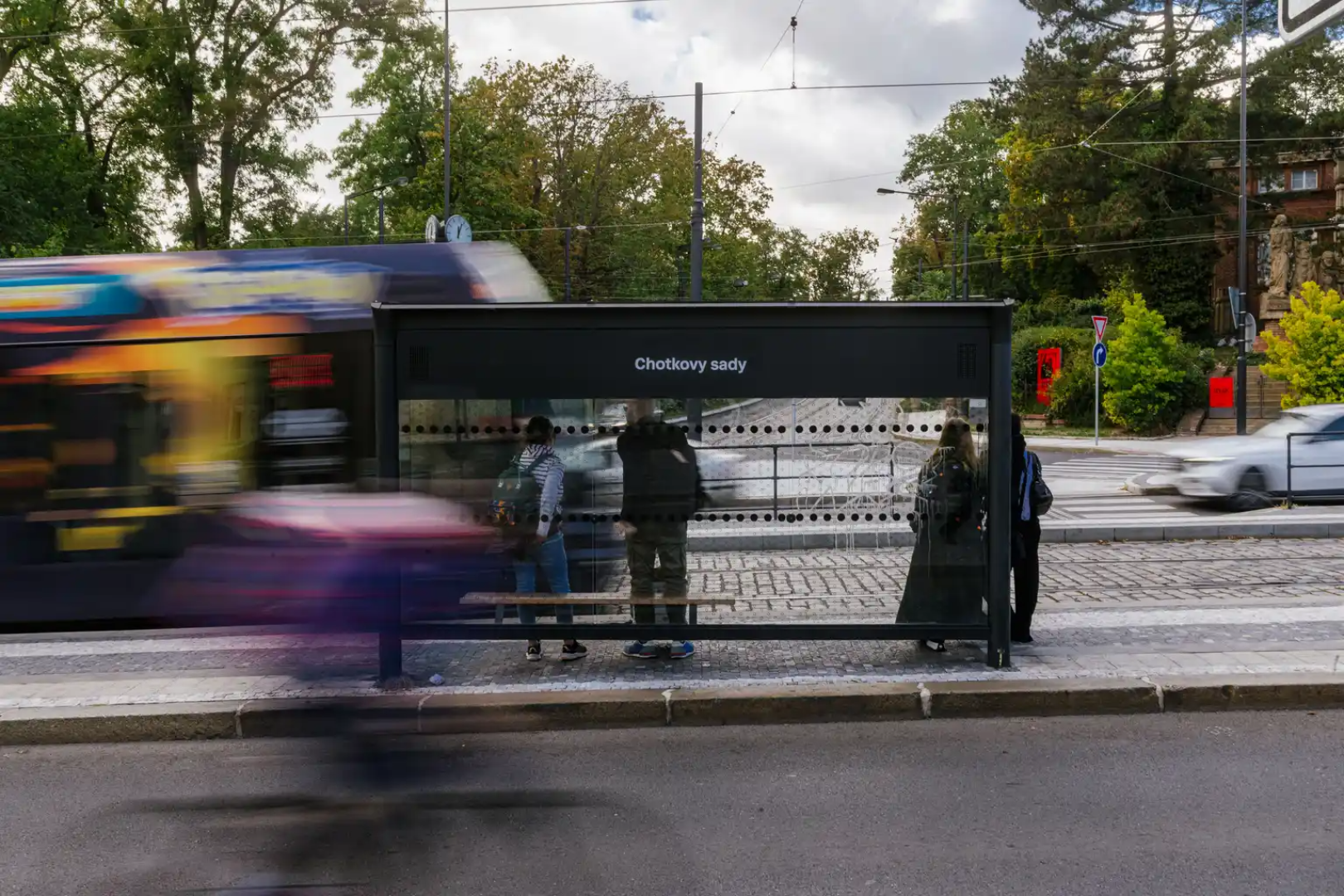
Jaromír Beránek, Deputy Mayor for Transport, notes that “Prague’s tram network is developing rapidly. We are experiencing a veritable tram boom, and it is important to us that trams not only provide transport services, but also serve as a flagship for improving public spaces in the areas through which they run.”
The standard defines what the tram network should look like in terms of surfaces, construction details, and street furniture. “Prague’s tram network covers an area of almost 1.25 million square meters, so its appearance is crucial,” says Ondřej Boháč, Director of IPR Prague. “The recently reopened line behind the National Museum shows that the appropriate use of high-quality materials can significantly transform a previously inhospitable place into a cultivated public space,” he adds.
The document provides recommendations for tram track coverings, stops, crossings, and other typical situations, including street furniture and information systems. It describes both the urban design that can be seen, for example, at the new Muzeum stop, as well as unconventional solutions, such as the use of drought-tolerant stonecrops and succulents between the tracks. This has proved successful near the Ládví stop, for instance.
The standards describe both visible design features, such as those seen at the new Muzeum stop, and unconventional solutions, including the use of drought-tolerant stonecrops and succulents between the tracks. This approach has proved successful near the Ládví stop, for instance.
Miroslav Penc, Head of the Facilities Unit at DPP, notes: “In preparing the document, DPP drew on its experience with the speed of assembly and disassembly of individual tram track components, operating costs, and the need to reuse materials that have to be removed when rails are replaced or a tram line is reconstructed.”
The standards are intended primarily for designers and will be publicly available on IPR Prague’s website. They are the result of an agreement between the city’s stakeholders, so everyone knows what to expect from tram tracks and unpleasant surprises can be avoided. The standards will make it easier to choose proven, high-quality solutions and plan material consumption. Because the standards are divided into individual chapters, they can be updated separately based on new experiences, making the document a living one.
Mohlo by Vás také zajímat
V IPR Praha vznikla Sekce koordinace. Propojuje plánování i povolování projektů
Kvalitnější dlažba i sukulenty mezi kolejemi. Praha představila Standard tramvajových tratí
