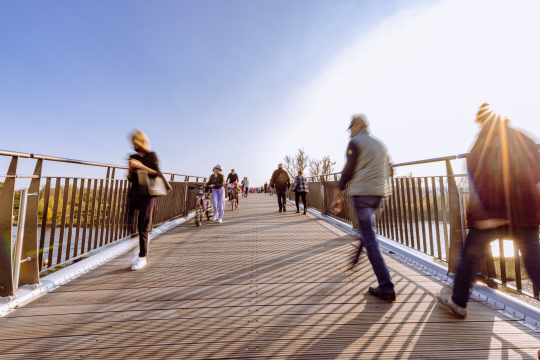
Prague is becoming an international metropolis. Its growth is driven by people from abroad, and it will increasingly depend on them.
A new study by the Prague Institute of Planning and Development (IPR Prague) shows that international residents have become a key part of the capital’s development. While the number of Czech citizens has stagnated or slightly declined over the long term, the number of international residents has increased almost sixfold over the past 20 years. Today, they account for a quarter of Prague’s population and hail largely from Ukraine, Slovakia, Russia, and Vietnam. Without this growth in the number of international residents, Prague’s population would be declining. This trend is expected to continue.
The number of international residents in Prague has been growing steadily. Between 2001 and 2024, their number increased from 61,000 to 354,000. By 2050, it could exceed 600,000. In 2022, many people arrived in the Czech Republic as a result of the war in Ukraine, bringing the number of Ukrainian citizens in Prague to 168,000. By the end of 2024, they accounted for almost half of all foreign nationals in the city. Slovak citizens make up approximately 9% of Prague’s foreign population, Russians 7% and Vietnamese 4.5%.
“International residents are an important part of Prague’s economy. They work in highly skilled professions as well as in sectors essential to the city’s day-to-day functioning, including construction, retail, services, gastronomy, and administration,” says Petr Hlaváček, Prague’s Deputy Mayor for Spatial and Strategic Development.
International residents also contribute to making Prague younger and strengthening its working-age population. The average age of foreign nationals is approximately 35.5 years, compared with almost 42 years for Prague’s population as a whole.
However, Ondřej Boháč, Director of IPR Prague, says: “In the long term, we cannot view international migration solely as a source of young labor. People arriving today will gradually grow older in Prague. The question for the future is therefore not whether Prague will be an international city — it already is one. The key challenge is to manage this transformation effectively by planning housing, schools, services, and infrastructure in a way that ensures the city remains functional and cohesive for all its residents”
Prague Is becoming more diverse, but not significantly more segregated
Most international residents live across different parts of the city rather than in concentrated enclaves, gradually becoming part of everyday life in Prague. Although international residents are more concentrated in certain neighborhoods than in others, the overall level of residential segregation remains low. Their participation in everyday life and society helps international residents acquire language skills, access educational and employment opportunities, and prevents inequalities from deepening.
It is important for the city to identify emerging barriers at an early stage and support affordable housing, accessible services, and opportunities for people to meet. These are essential to ensuring that all residents can participate fully in the life of the city.
Mohlo by Vás také zajímat
Knižní hostina v industriální hale. Centrum architektury a městského plánování otevírá nové prostory v Karlíně

Hřbitovy jsou pro Pražany místem pro pietu i sport. Jejich vztah k pohřbívání se mění